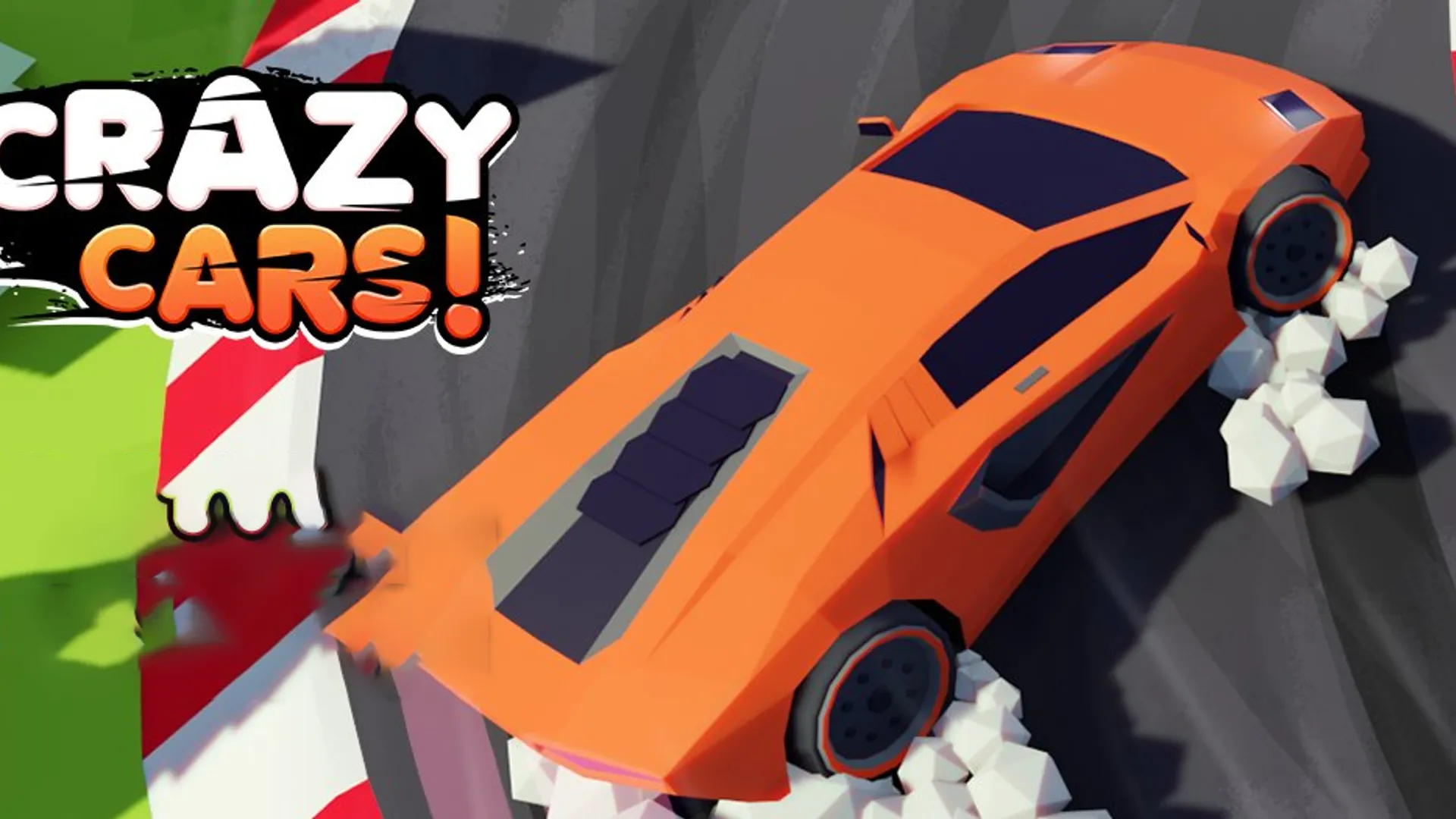
The moment you spawn into the expansive map of Crazy Cars, you are completely free from the constraints of traditional lap-based racing. The fundamental interaction loop here is purely exploratory and physics-driven. Your input dictates immediate acceleration, and the environment is scattered with launch pads, massive loops, and uneven terrain. Crazy Cars does not force you onto a specific path; instead, it provides a sprawling playground designed to push the vehicle's suspension and momentum limits to their absolute breaking point.
When navigating this world, the primary mechanical challenge in Crazy Cars is maintaining control during extreme verticality. Launching off a ramp at maximum speed sends your vehicle airborne, requiring mid-air pitch adjustments to avoid landing upside down. A failed landing in Crazy Cars results in a chaotic, tumbling crash that bleeds all your accumulated momentum. Mastering the terrain means understanding exactly how your current vehicle interacts with varied inclines and drops.
Exploration in Crazy Cars is heavily incentivized through a physical collectible system. Stars and wrenches are physically placed on top of shipping containers, inside narrow pipes, or floating mid-air above challenging jumps. To acquire them, players must treat Crazy Cars as a platforming game where the vehicle is the character. You must calculate the exact speed and trajectory needed to reach these specific coordinates.
This collectible hunt adds a layer of precision to the otherwise chaotic gameplay of Crazy Cars. You cannot simply hold the accelerator and hope to grab a star suspended above a quarter-pipe. You must brake, align your tires perfectly, and feather the throttle. This mechanical contrast between high-speed stunts and low-speed precision platforming defines the unique rhythm of Crazy Cars.
The inclusion of local split-screen multiplayer transforms Crazy Cars into a competitive arena. When two players share the same physical map in Crazy Cars, collision physics become a central mechanic. You can actively ram your opponent mid-jump, altering their trajectory and causing them to miss a crucial collectible or crash into a barrier.
This multiplayer mode in Crazy Cars relies entirely on the same underlying physics engine as the single-player experience. The weight and speed of your chosen vehicle directly impact how much force you can apply to an opponent during a collision. Therefore, choosing a heavier truck in Crazy Cars might give you a combative edge, even if it sacrifices the top speed needed for massive ramp jumps.
Cornering effectively in Crazy Cars requires a deep understanding of its drifting mechanics. When you initiate a hard turn at high speed, the rear tires lose traction, forcing the vehicle into a slide. In Crazy Cars, you must aggressively counter-steer to maintain the drift angle without spinning out completely. The physics engine calculates this loss of traction dynamically based on your entry speed and steering input.
Successfully holding a drift in Crazy Cars allows you to maintain a higher average speed through tight obstacle courses than standard braking would allow. However, the surface material also impacts traction. Transitioning from asphalt to dirt in Crazy Cars completely alters the friction coefficient, requiring immediate adjustments to your steering inputs to prevent a catastrophic crash.
Mid-Air Control Systems:Unlike realistic simulators, Crazy Cars implements a mid-air rotation mechanic that grants players control while airborne. Using the directional inputs while off the ground applies rotational torque to the vehicle. This mechanic in Crazy Cars is not just for performing flashy flips; it is a critical survival tool used to align the tires with the landing surface.
Landing perfectly flat on all four tires preserves your momentum in Crazy Cars, allowing for immediate acceleration upon touchdown. Conversely, landing on your bumper or roof triggers the collision physics, violently halting your progress. Mastering this mid-air pitch and roll in Crazy Cars separates novice drivers from stunt veterans.
"The real trick here is treating the brake pedal as a weight-transfer tool rather than just a way to stop. Tapping the brake right before a jump in Crazy Cars compresses the front suspension, giving you a completely different launch trajectory." - Veteran Gamer Sentiment
The progression loop in Crazy Cars revolves heavily around acquiring the 17 unique vehicles available in the garage. These are not merely cosmetic reskins in Crazy Cars. Each vehicle in Crazy Cars possesses distinct physical properties: mass, acceleration curves, top speed, and suspension travel. A lightweight sports car will handle completely differently on a dirt ramp compared to a heavy off-road buggy.
To unlock these higher-tier vehicles, players must aggressively hunt down the stars scattered across the map. This creates a satisfying gameplay loop in Crazy Cars: use a basic car to reach easy stars, unlock a faster car, use its increased speed to clear a massive gap, and acquire the harder-to-reach stars. The mechanical capabilities of your garage dictate which parts of the Crazy Cars map you can successfully conquer.
| Developer | Noob Games |
|---|---|
| Genre | 3D Arcade Racing |
| Multiplayer | 2-Player Local Split-Screen |
| Core Mechanic | Physics-based driving and stunts |