STATUS: ACTIVE // VETERAN GAMER REVIEW
The "masocore" platforming genre, famously popularized by titles designed explicitly to infuriate players, has found a new, brutally distilled champion in Devil Die. On the surface, the visual presentation of Devil Die might look like a standard, retro-inspired 2D platformer. You control a fragile avatar navigating through an underworld landscape comprised of floating blocks, spikes, and lava pits. However, the moment you press the jump button in Devil Die, the cruel reality of its game design becomes immediately apparent. This is not a game about exploring a vibrant world or collecting shiny coins; Devil Die is a psychological test of endurance, memory, and anger management. It fundamentally subverts the traditional rules of platforming by weaponizing your own expectations against you. In Devil Die, a safe-looking platform will suddenly sprout lethal spikes, invisible blocks will block your jump arcs, and seemingly harmless background elements will detach and crush you. Surviving Devil Die requires unlearning everything you know about intuitive game design and embracing a cycle of continuous, spectacular failure.
The defining characteristic that sets Devil Die apart from conventional difficult platformers is its reliance on hidden traps and subverted expectations. In a typical game, if you see a gap, you jump over it. In Devil Die, jumping over that gap might trigger an invisible wall that bounces you directly into a pit of lava. If you see a coin floating tantalizingly above a platform, attempting to collect that coin in Devil Die will almost certainly trigger a falling anvil.
This mechanic of betrayal is the core hook of Devil Die. The developers have meticulously studied how experienced gamers navigate 2D spaces, and they have placed traps exactly where your muscle memory tells you to land. Playing Devil Die for the first time is an exercise in extreme paranoia. You quickly learn that you cannot trust your eyes. The only way to progress in Devil Die is through trial and error. You walk forward, you die to a trap you couldn't possibly have seen coming, and you memorize its location for the next attempt. This creates a deeply addictive, iterative gameplay loop where progress in Devil Die is measured not in levels completed, but in inches of screen space memorized.
The brilliance of this design in Devil Die is that it transforms frustration into a bizarre form of comedy. When you manage to dodge a falling ceiling, only to step on a hidden spring that launches you into a completely different spike pit, the absurdity of the death is genuinely funny. The game is laughing at you, and eventually, playing Devil Die forces you to laugh at yourself.
The sheer variety of ways the environment can kill you in Devil Die is staggering. The game does not rely on a single gimmick; instead, it constantly introduces new methods of subverting your progress. The invisible block is perhaps the most notorious mechanic in Devil Die. These blocks exist in the game world but are completely hidden from the player until they are struck from below. The developers of Devil Die intentionally place these invisible blocks in the exact trajectory of your required jumps. Hitting one mid-air instantly kills your momentum and drops you into the abyss.
Another staple mechanic in Devil Die is the fake terrain. A solid brick floor might visually appear safe, but stepping on specific tiles will cause them to instantly vanish, dropping you into a spike pit. Conversely, some spikes in Devil Die are purely cosmetic illusions that you can safely walk through, designed to force you into taking a more dangerous alternate route. Deciphering what is real and what is a deadly illusion is a constant mental puzzle in Devil Die.
Furthermore, Devil Die frequently employs proximity-based trigger traps. These traps activate only when your character enters a highly specific, invisible radius. A ceiling spike might suddenly detach and fall in Devil Die only when you reach the exact center of a platform. Surviving these triggers requires you to inch forward, constantly probing the hitboxes, ready to instantly reverse your momentum at the first sign of movement.
While memorization is the key to identifying the traps, executing the safe route in Devil Die requires grueling physical precision. Even when you know exactly where a trap is located, the platforming physics in Devil Die are completely unforgiving. The game features no momentum-based sliding or coyote-time (the hidden mechanic in modern platformers that allows you to jump slightly after walking off an edge). In Devil Die, if you walk one pixel past the edge of a block, you fall.
Key Insight:The jumping physics in Devil Die are characterized by a heavy, rigid arc. You have very little mid-air control over your character. Once you commit to a jump in Devil Die, your trajectory is locked in. This means that positioning yourself before the jump is paramount. A jump executed from the center of a block will result in a completely different landing spot than a jump executed from the very edge, and Devil Die frequently requires the latter to clear its massive chasms.
This strict adherence to rigid physics means that "fluking" your way through a level in Devil Die is mathematically impossible. You cannot mash buttons or wildly alter your path mid-flight to correct a mistake. Every successful sequence of jumps in Devil Die must be calculated and executed with absolute, robotic precision.
For players attempting to beat the game without dying hundreds of times, or for speedrunners looking to optimize their clear times, Devil Die demands a mastery of micro-movements. Because the traps are triggered by specific hitboxes, advanced players learn how to "bait" the triggers without fully committing their body to the danger zone.
In Devil Die, this is often achieved through rapid, tapping inputs on the movement keys. Instead of holding the right arrow key to walk, high-level players of Devil Die will tap it sequentially, advancing a few pixels at a time. This micro-movement strategy allows them to trigger falling spikes or collapsing floors while maintaining enough backward momentum to immediately retreat to safety. While this strategy is slow, it is the only reliable way to "sight-read" a new level in Devil Die without relying entirely on dying to discover the traps.
Once the locations of all the traps in a specific stage of Devil Die have been memorized, the gameplay completely shifts from cautious probing to a high-speed rhythm game. Because the physics are entirely deterministic, a perfectly executed sequence of inputs will always result in a successful run.
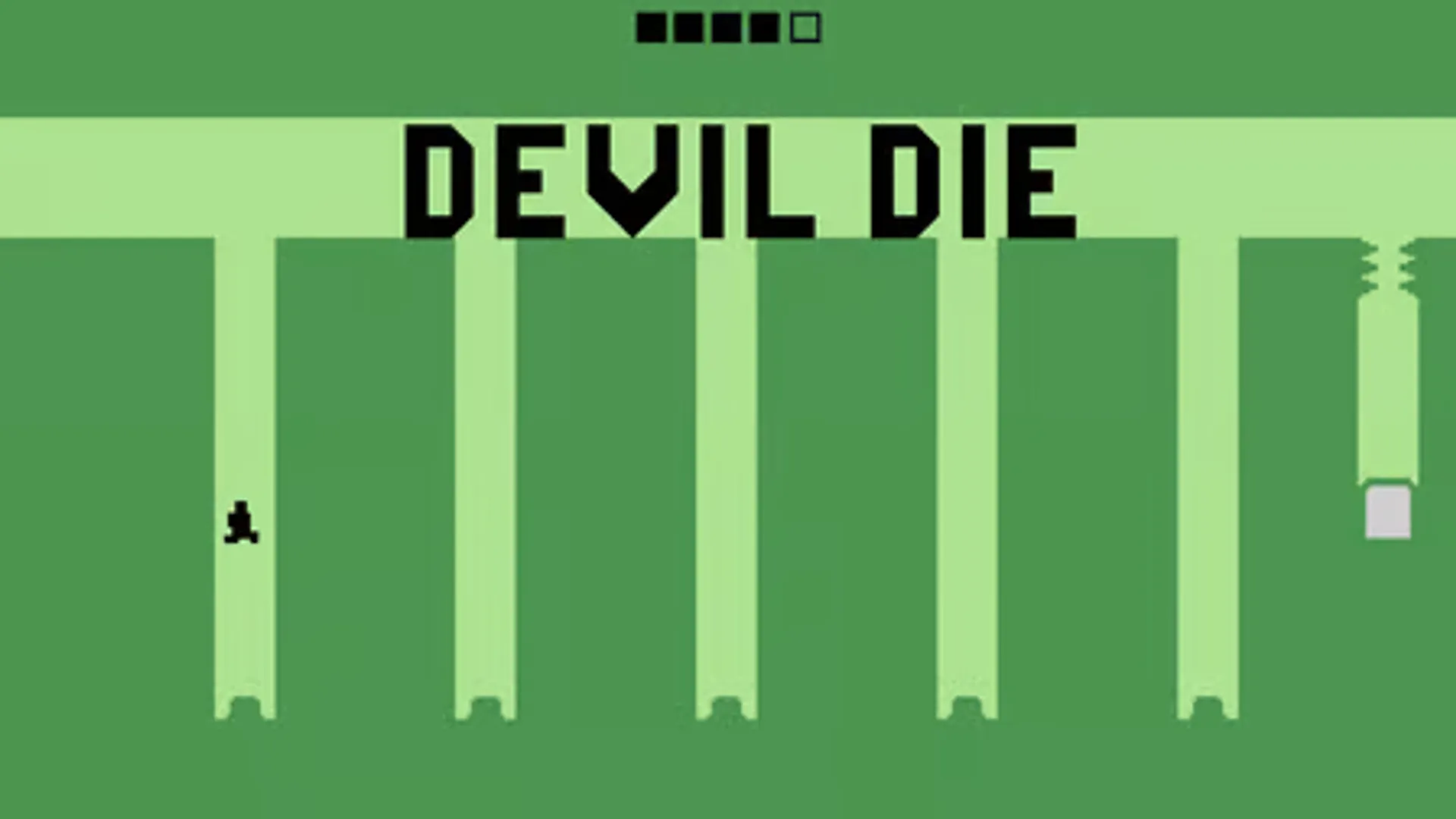
The aesthetic of Devil Die is intentionally nostalgic, heavily borrowing from the 8-bit era of gaming where unfair difficulty was the standard method of padding out a game's runtime. The color palette in Devil Die is dominated by oppressive reds, stark blacks, and fiery oranges, reinforcing the "underworld" theme. The chiptune soundtrack loops endlessly, providing an upbeat, frantic background noise that bizarrely contrasts with the sheer misery of the gameplay.
The sound effects in Devil Die are sharp and abrasive. The death sound—a loud, digital crunch—will become deeply embedded in your psyche. But this sensory abuse is exactly what makes the game so rewarding. The dopamine hit provided by Devil Die is unlike any other game. When you finally string together thirty flawless, pixel-perfect jumps and successfully navigate a gauntlet of invisible blocks, fake floors, and falling ceilings, the sense of relief is overwhelming. Beating a level in Devil Die doesn't make you feel like a hero; it makes you feel like a survivor who has just outsmarted a deeply malicious entity.
Devil Die is the definition of a niche experience. It is not designed to be fair, balanced, or universally enjoyable. It is a hostile piece of software that actively hates the person playing it. If you believe that video games should respect your time and provide a smooth, logical learning curve, you must avoid Devil Die at all costs. It will only cause you profound stress and frustration.
However, if you are a fan of the "rage game" genre—games like "I Wanna Be The Guy" or "Syobon Action"—then Devil Die is an absolute masterclass in malicious design. It offers a pure, unadulterated test of mechanical skill and mental fortitude. For the hardcore masochists who find joy in overcoming seemingly impossible, unfair odds, Devil Die is a brilliantly executed nightmare that you will love to hate.
Level 5 in Devil Die introduces invisible ceiling spikes. To pass it, you cannot do full jumps. You must execute three consecutive "short-hops" across the lava pit by quickly tapping the jump button instead of holding it down.
The "fake flag" is a notorious trap in Devil Die. When you reach the end of the level, DO NOT touch the green flag immediately. Jump entirely over it to hit the hidden true flag located just off-screen to the right.
Absolutely. Devil Die is explicitly designed within the masocore "rage game" genre. Its primary mechanic is tricking the player through subverted expectations and invisible traps.