STATUS: ACTIVE // VETERAN GAMER REVIEW
The point-and-click adventure genre has experienced a massive resurgence in recent years, but many modern titles prioritize cinematic storytelling over actual gameplay, offering simple puzzles that insult the player's intelligence. Forgotten Hill: Fall violently rejects this trend, dragging the genre back to the golden era of brutal, unforgiving, logic-based horror. When you boot up Forgotten Hill: Fall, there is no lengthy tutorial explaining the mechanics, and there is no glowing objective marker guiding your every step. You are simply dropped into the freezing woods on a moonless night after a car accident, forced to seek shelter in an isolated, decaying cabin. From the very first screen, Forgotten Hill: Fall establishes an atmosphere of oppressive dread. It is a game that respects its audience, demanding extreme observational skills, meticulous note-taking, and an iron stomach to survive the grotesque horrors lurking within its walls. If you are tired of interactive movies masquerading as puzzle games, Forgotten Hill: Fall offers a genuinely terrifying, cerebrally taxing experience that will push your deductive reasoning to its absolute limits.
The defining characteristic of Forgotten Hill: Fall is its complete reliance on environmental storytelling. The game does not spoon-feed you exposition through lengthy dialogue trees or convenient audio logs. Instead, the narrative of Forgotten Hill: Fall must be painstakingly pieced together from the environment itself.
Every bloodstain on the floorboards, every ripped painting hanging askew on the wall, and every cryptic symbol carved into a wooden door in Forgotten Hill: Fall serves a distinct purpose. This design philosophy forces you to engage with the game world on a much deeper level than standard escape room titles. You cannot simply sweep your mouse across the screen looking for interactive hotspots. In Forgotten Hill: Fall, you must analyze the context of the room. The macabre arrangement of taxidermy animals in the parlor might actually be the solution to a complex combination lock upstairs. By refusing to explicitly tell you what is happening, Forgotten Hill: Fall creates a constant, gnawing sense of paranoia. You are never entirely sure if a disturbing detail is just set dressing or the critical missing piece to a puzzle you've been stuck on for an hour.
The inventory management in Forgotten Hill: Fall is an exercise in the grotesque. Unlike traditional adventure games where you collect keys and crowbars, the items you must gather and combine in Forgotten Hill: Fall are often deeply disturbing.
You will find yourself carrying jars of pickled organs, severed appendages, and rusted, blood-stained surgical tools. The core gameplay loop involves navigating the labyrinthine cabin, encountering an insurmountable obstacle, and then scouring previous rooms to find an esoteric item that might provide a solution. However, the logic in Forgotten Hill: Fall is intentionally twisted, reflecting the madness of the cabin's inhabitants. A traditional game might require a key to open a locked wooden chest. In Forgotten Hill: Fall, you might need to extract the teeth from a mounted deer head, place them into a demonic idol, and catch the resulting black ichor in a chalice just to lubricate the rusted hinges of a door. This dream-logic forces you to abandon rational thought and embrace the nightmare logic of the developers.
Adding to the intense pressure is the fact that Forgotten Hill: Fall is not a safe game. Many point-and-click adventures allow you to experiment freely without consequence. In Forgotten Hill: Fall, making the wrong choice frequently results in a sudden, violent death.
Key Insight:These death traps are not random; they are always foreshadowed. The genius of Forgotten Hill: Fall is that it punishes impatience. If you find a dark, gaping hole in the wall, your instinct might be to reach inside to see if there is a hidden item. In Forgotten Hill: Fall, doing so without first shining a light inside will result in your hand being severed by a hidden blade, triggering an instant Game Over. This constant threat of death forces you to meticulously evaluate every single interaction. You must read the warnings, study the environmental clues, and think three steps ahead before committing to an action, making Forgotten Hill: Fall a deeply psychological endurance test.
While the opening sequence of Forgotten Hill: Fall is relatively straightforward, the game rapidly opens up into a non-linear nightmare. Once you gain access to the main hallway, you are presented with half a dozen locked doors and an overwhelming number of potential puzzle threads.
The game does feature a built-in hint system, but in true Forgotten Hill: Fall fashion, it is deliberately cryptic. Rather than explicitly telling you what to do, the hints often take the form of disturbing riddles or blood-scrawled drawings. Relying too heavily on these hints can actually increase your confusion. The true satisfaction in Forgotten Hill: Fall comes from completely ignoring the hint system and relying entirely on your own deductive reasoning to break the game's complex logic structures.
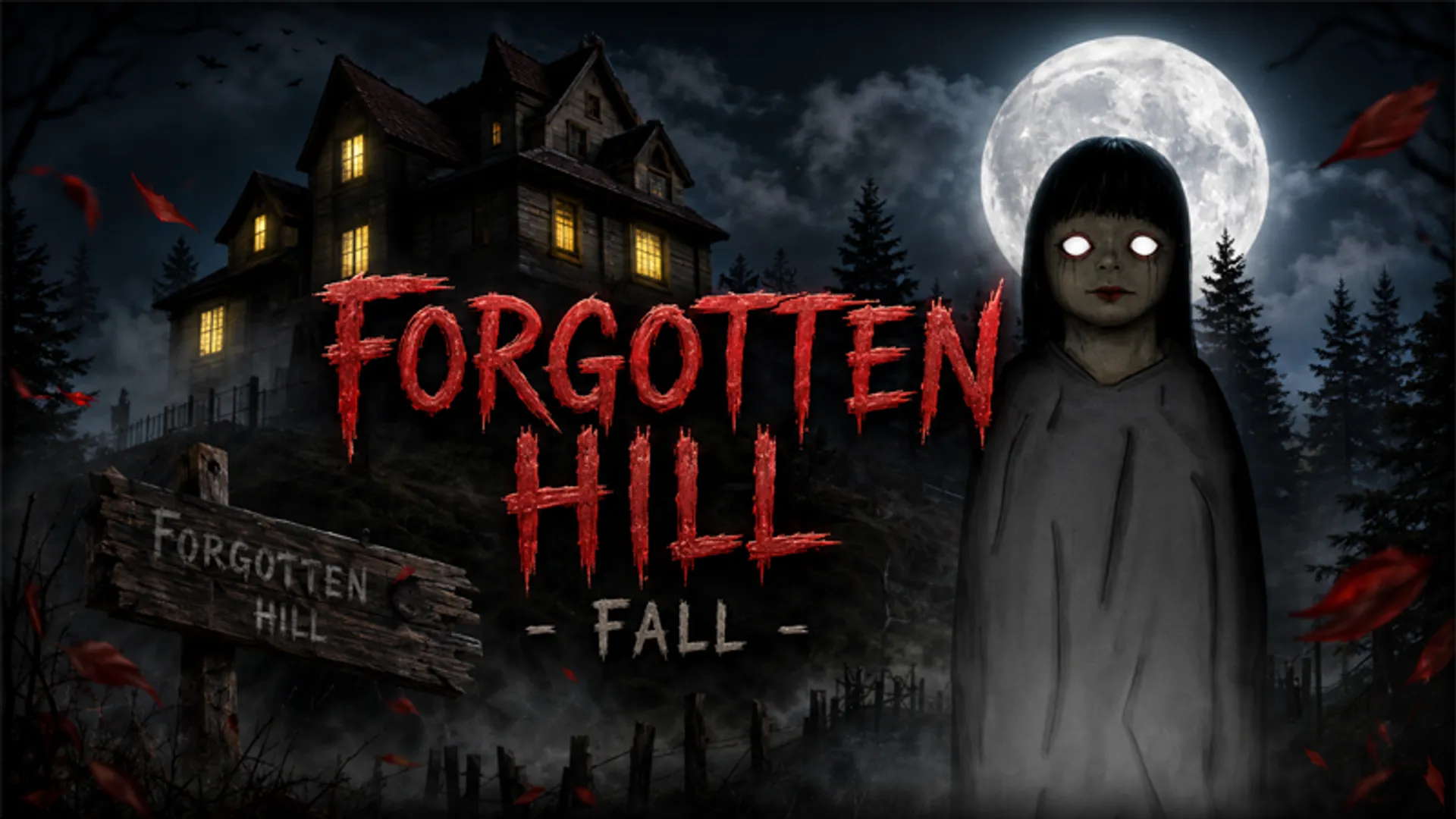
The aesthetic presentation of Forgotten Hill: Fall is a masterclass in lo-fi horror. It does not rely on hyper-realistic 3D graphics to scare you. Instead, it utilizes a deeply unsettling, hand-drawn 2D art style characterized by harsh shadows, desaturated colors, and grotesque character designs. The static nature of the point-and-click interface in Forgotten Hill: Fall actually amplifies the horror; because you cannot fluidly turn your head to check your corners, you always feel incredibly vulnerable.
The sound design is minimal but highly effective. There is very little background music in Forgotten Hill: Fall. The audio landscape consists primarily of ambient noise—the howling wind outside, the creaking of the floorboards beneath your feet, and the sudden, terrifying sound of something heavy dragging itself across the ceiling above you.
The dopamine hit in Forgotten Hill: Fall is incredibly potent because it is so hard-earned. The puzzles are brutal, and the atmosphere is suffocating. When you finally deduce the solution to a complex, multi-stage puzzle that has had you stuck for forty-five minutes, the sense of intellectual triumph is overwhelming. In Forgotten Hill: Fall, you do not feel like a powerful action hero; you feel like a desperate survivor who just barely managed to outsmart a sadistic architect.
Forgotten Hill: Fall is definitively not for everyone. It is a bleak, challenging, and frequently disturbing game that requires patience, critical thinking, and a tolerance for gore. It makes absolutely zero concessions for casual players.
However, if you are a fan of classic escape room titles like the "Cube Escape" series or early 90s horror adventures, Forgotten Hill: Fall is an absolute masterpiece. It brilliantly captures the feeling of being trapped in a waking nightmare. If you want a game that will genuinely challenge your intellect, force you to take physical notes, and leave you feeling deeply unsettled long after you close your browser, Forgotten Hill: Fall is a mandatory addition to your library.
To solve the piano puzzle in Forgotten Hill: Fall, you must examine the bloody sheet music found in the master bedroom. The correct sequence of keys corresponds to the notes C, E, G, B, triggering a secret compartment to open.
Escaping the cabin requires combining the fuse, the silver key, and the gasoline canister. First, restore power to the basement generator, then use the silver key to unlock the main door padlocks in Forgotten Hill: Fall.
The fuse is located inside the grandfather clock in the hallway. You must set the clock's hands to exactly 3:15, matching the time written on the back of the torn photograph you find in the kitchen.