STATUS: ACTIVE // VETERAN GAMER REVIEW
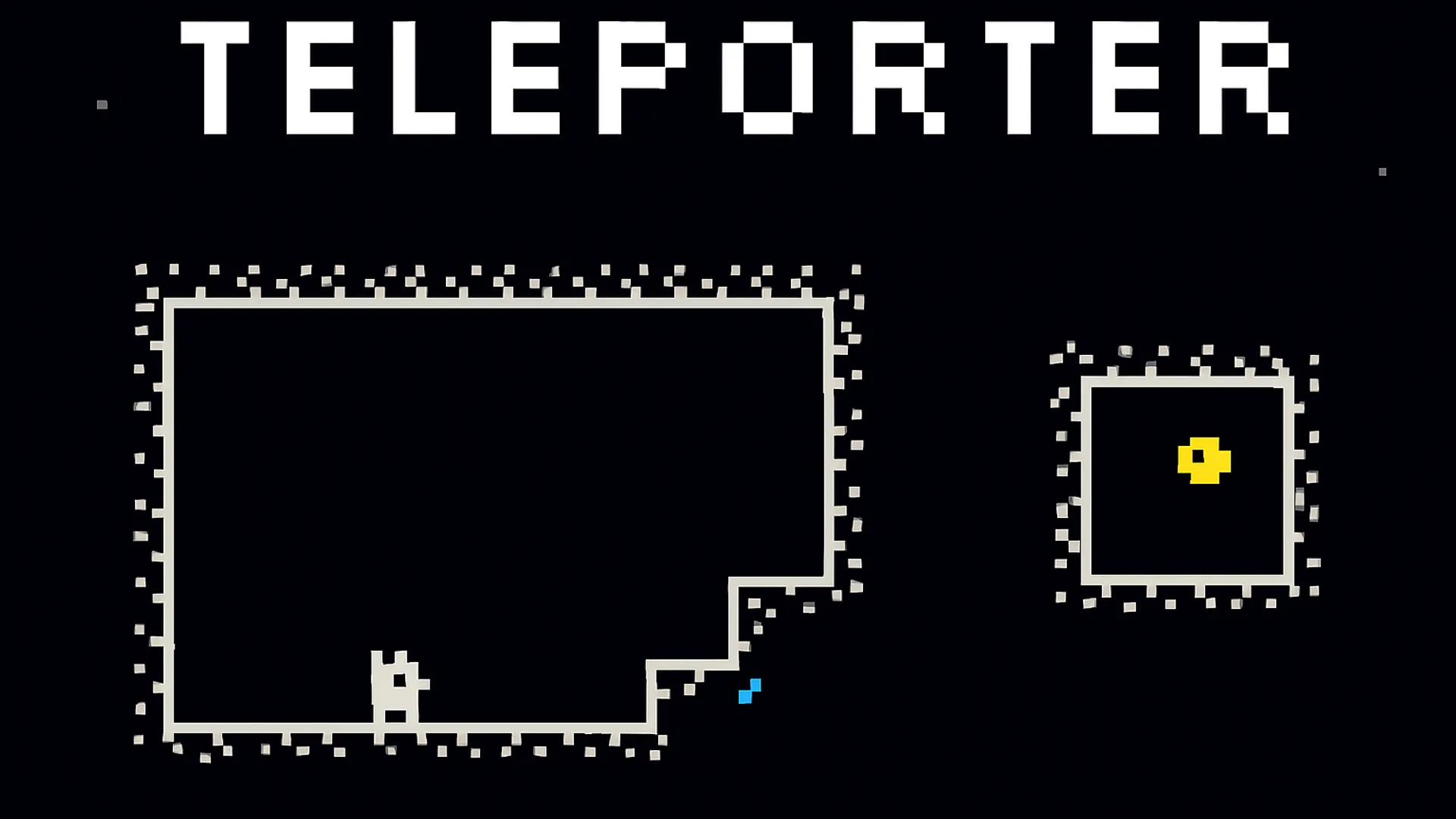
When you first boot up Teleporter, it seems like a straightforward, if slightly abstract, logic game. The premise tasks you with gathering bright yellow dots scattered across the map. The unique twist is the dual-screen mechanic: one environment serves as the space for physical movement, while a completely separate, disconnected environment contains the actual collectibles. To bridge the gap, you must use the game's namesake mechanic. The early levels of Teleporter introduce this gently, letting you easily link the two worlds by estimating simple distances.
However, this gentle introduction is a complete trap. Teleporter rapidly evolves from a casual logic puzzle into a brutally demanding test of spatial reasoning and geometric precision. If you attempt to play Teleporter in the later stages by just "eyeballing" the coordinates and guessing where you will land, you will instantly warp directly into fatal geometry, ending the run. The game heavily punishes spatial inaccuracy.
I’ve spent an absurd amount of time trying to perfect-clear the deeper zones of Teleporter, and the difficulty curve is absolutely sadistic. The game stops offering you clear sightlines and starts filling the alternate dimensions with complex, overlapping hazards—solid walls that instantly crush you upon materialization, moving energy fields, and shifting target dots. In Teleporter, every single warp must be calculated mathematically.
Surviving the final tiers of Teleporter requires a fundamental shift in your gaming mindset. You have to transition from playing instinctively to playing like a surveyor. You aren't just reacting to the screen; you are mapping X and Y coordinates in your head, translating distance from one entirely different map to another. Elite veterans playing the game often pause the game, mentally drawing vectors across the UI before executing a single input.
The most punishing mechanical element of Teleporter is how it handles the coordinate translation. The game does not offer a grid or a trajectory arc. The entire challenge revolves around knowing exactly how the scale of the movement room maps onto the hazard room, trusting your own internal sense of distance.
The most vital technique for conquering Teleporter is mastering "vector anchoring." Since the game provides zero visual aids, randomly guessing distance is suicide.
Casual players constantly die in Teleporter because they suffer from perspective drift, failing to realize that moving two inches on the left screen translates precisely to the same coordinate on the right screen. Veterans of Teleporter rely on intense environmental scanning. They utilize vector anchoring—using static background elements or specific corners of the UI as reference points to establish a mental grid, perfectly aligning their jumps before committing. This intense, calculated positioning is what separates the frustrated beginners from the true masters of Teleporter.
Another massive hurdle in Teleporter is the momentum system. The game frequently forces you to warp while already in motion. You do not have the luxury of standing perfectly still and calculating the geometry in the later action-oriented stages.
This mechanical strictness creates a brilliant tension. In Teleporter, your physical velocity carries over through the warp. If you jump into a warp gate while falling, you will materialize in the next room falling at the exact same speed. Elite players utilize a technique called "momentum buffering"—intentionally warping into a wall to arrest their speed, or using a precise jump arc to seamlessly land on a moving platform in the alternate dimension. By fully embracing this high-execution physics interaction in Teleporter, veterans can safely snatch the most heavily guarded targets with zero margin for error.
For the hardcore speedrunning community obsessed with logging the fastest possible clear times in Teleporter, playing methodically is entirely too slow. The highest tier of play revolves around manipulating the spawn coordinates and exploiting the way the engine calculates collision upon materialization.
These extreme tactics in Teleporter demand terrifying execution. Nailing a perfect collision skip requires incredibly precise coordinate alignment. If you miss the vector by a fraction of a pixel in Teleporter, the character instantly splatters against the wall.
The aesthetic presentation of Teleporter is deliberately designed to feel stark and disorienting. The harsh neon geometry, the stark contrast between the two dimension screens, and the complete lack of organic details create a feeling of clinical isolation. The audio design in Teleporter provides sharp, electronic feedback for every successful warp, but punishes your failures instantly with a jarring, dissonant crash. The game actively demands your complete mental focus.
This psychological pressure makes the core loop of Teleporter surprisingly addictive. When you finally pull off a flawless sequence through a spatial puzzle that has crushed you twenty times—perfectly anchoring the vectors, exploiting the momentum carry, and securing the final dot—the feeling of relief is massive. Teleporter rewards you with the profound dopamine hit of mastering a complex geometric system through sheer brain power.
Key Insight: Teleporter is a masterful, deceptively vicious distillation of the hardcore spatial puzzle genre. It takes a highly abstract visual aesthetic and wraps it around a heavily punishing, mathematically strict mechanical engine. Conquering the final dimensions in Teleporter requires sweat-inducing focus, punishing blind guessing and rewarding perfect coordinate mapping with brutal efficiency.
If you are the type of hardcore gamer who thrives on dissecting spatial relations, optimizing jump arcs, and executing flawless warps under extreme pressure, Teleporter is an absolute must-play. Stop treating it like a casual browser game and start respecting the geometry. Lock in your vector anchors, master the momentum buffers, and show the leaderboards of Teleporter exactly what a flawless execution looks like. The alternate dimension is waiting, and only the most technically proficient players will bridge the gap.
No. In Teleporter, the UI is completely bare. You must rely entirely on your own internal sense of distance and scale to translate coordinates between the two screens.
Absolutely not. Once the input is pressed in Teleporter, the character materializes instantly. If your math was wrong and you warp into a solid block, you must restart the puzzle entirely.