
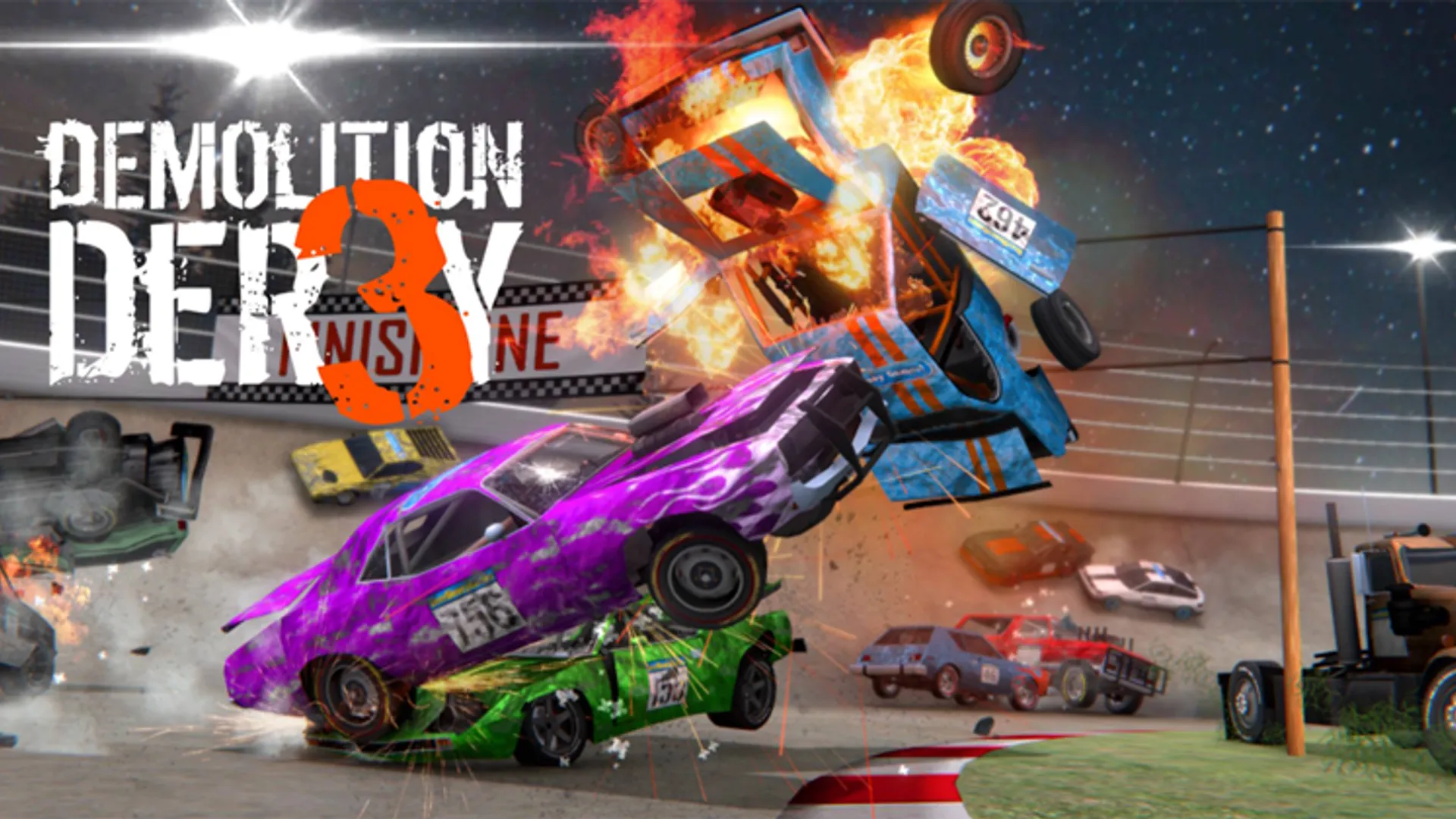












Demolition Derby 3: Drive 100 Vehicles in Chaotic Arenas
The core mechanical loop of Demolition Derby 3 is built upon relentless vehicular combat and physics-driven destruction. Unlike clean circuit racing, success in Demolition Derby 3 requires you to weaponize the chassis of your car. You drop into enclosed dirt arenas and paved tracks with one fundamental objective: inflict maximum kinetic damage on opponent vehicles while preserving your own engine block. The game engine rigorously tracks deformation, meaning every heavy impact visually and mechanically degrades the performance of your machine until it inevitably stalls out.
Dropping into the Arena of Destruction
The Art of the T-Bone
Surviving the initial chaos in Demolition Derby 3 requires an immediate understanding of hitboxes and momentum. The most devastating maneuver you can execute is the T-Bone collision. Striking an opponent’s vehicle directly on their side doors transfers the maximum amount of kinetic energy from your front bumper into their vulnerable frame. When you land a high-speed T-Bone in Demolition Derby 3, the physics engine responds with intense screen shake and flying debris, instantly crippling the rival car’s mobility and significantly reducing their health bar.
Conversely, head-on collisions in Demolition Derby 3 are mechanically inefficient. When two vehicles strike front bumpers at high speeds, the damage is distributed equally. Your own engine block absorbs a massive hit, which can lead to a stalled engine and premature elimination. The true skill in Demolition Derby 3 lies in utilizing the right-side acceleration and brake pedals to manipulate your trajectory, ensuring that you always strike with your armored front while protecting your own fragile radiator.
Managing the Health System
Every vehicle in Demolition Derby 3 is governed by a strict health system that dynamically affects handling. As your car takes damage, the visual deformation is not merely cosmetic. Crushed axles cause your vehicle to pull sharply to one side, forcing you to constantly fight the virtual steering joystick just to drive in a straight line. Heavy rear-end damage can lock up the rear wheels, turning your car into an unsteerable sled sliding across the mud. Demolition Derby 3 requires players to actively manage this degradation during long arena sessions.
When your health bar reaches critical levels, aggressive play is no longer viable. Demolition Derby 3 forces you to adopt evasive maneuvers, using the reverse pedal to back out of scrums and circling the perimeter of the arena. You must wait for the AI drivers to weaken each other, diving in only to deliver the final killing blow to a smoking, barely-functioning rival vehicle. This predatory approach is essential for surviving the grueling endurance matches in Demolition Derby 3.
The Physics of Metal Bending and Dirt Drifting
Handling on Varied Terrain
Demolition Derby 3 features over 50 distinct tracks and arenas, and the terrain type directly impacts your vehicle's handling model. On paved tracks, the tires grip the road firmly, allowing for rapid acceleration and precise cornering. However, when you transition to the mud and dirt arenas, the friction coefficient drops significantly. Demolition Derby 3 demands that players master the art of controlled drifting. By tapping the brake pedal while steering sharply on a dirt surface, you can kick out the rear end of the car, swinging your heavy trunk into opponents like a wrecking ball.
The first-person driving perspective in Demolition Derby 3 amplifies the intensity of these physical interactions. From the dashboard view, the limited visibility makes navigating the chaotic dirt arenas significantly harder. You must rely on peripheral vision and audio cues to dodge incoming attacks, as the lack of a free-look camera restricts your ability to check your blind spots. Mastering the terrain in Demolition Derby 3 means understanding when to sacrifice speed for stability.
Navigating Without Free-Look
One of the most defining constraints of Demolition Derby 3 is the rigid camera system. Because the mobile interface relies on on-screen buttons for acceleration and steering, there is no dedicated thumbstick for panning the camera. You cannot look behind you or swipe to check your flanks. This mechanical limitation means that situational awareness in Demolition Derby 3 is almost entirely dependent on the mini-map radar and predictive positioning.
To avoid being blindsided, veteran players in Demolition Derby 3 learn to never stay stationary. If you are not actively moving, you are a sitting target. By constantly feathering the gas pedal and maintaining a wide turning radius, you minimize the chances of an opponent landing a devastating hit on your rear axle. The rigid camera forces a hyper-aggressive playstyle, as driving defensively without rear visibility is a guaranteed path to elimination in Demolition Derby 3.
Garage Upgrades and Financial Grind
Unlocking the 100-Vehicle Roster
Progression in Demolition Derby 3 revolves around the extensive garage system. The game boasts a roster of over 100 vehicles, ranging from rusty compact sedans to heavy-duty pickup trucks and armored vans. You purchase these vehicles using credits earned from competing in campaign events and arena matches. In Demolition Derby 3, heavier vehicles naturally inflict more damage and possess larger health pools, but they suffer from sluggish acceleration and wide turning circles.
Choosing the right vehicle for the specific event is critical. A nimble sports car might excel in the pure racing circuits of Demolition Derby 3, but it will be crushed instantly in a heavy-metal arena deathmatch. You must grind for credits to build a diverse fleet. Demolition Derby 3 does not rely on pay-to-win mechanics; instead, it demands a steady investment of time to unlock the higher-tier vehicles that are necessary to survive the late-game campaign stages.
Performance Upgrades and Armor Plating
Beyond purchasing new cars, Demolition Derby 3 allows for deep mechanical customization. You can spend your hard-earned credits to upgrade the engine, transmission, suspension, and tires. More importantly, you can install heavy armor plating on your chassis. Upgrading your armor in Demolition Derby 3 directly increases your vehicle's damage resistance, allowing you to survive massive impacts that would otherwise total a stock car.
These upgrades are not cheap. The financial grind in Demolition Derby 3 requires players to replay earlier arenas and complete daily challenges to amass enough wealth. Every time you enter the garage, you must decide whether to invest your credits into a faster engine to outrun opponents, or thicker armor to outlast them in the brutal demolition pits. This economic balancing act ensures that Demolition Derby 3 remains engaging long after you have mastered the driving mechanics.
"In the heavy dirt arenas, stop trying to use your front bumper for every hit. Learn the 'J-Turn Smash'. Build up speed in reverse, whip the steering wheel to swing the heavy rear trunk around, and slam the back of your car into the opponent's engine block. You save your own radiator and deal massive damage." - Veteran Insight
Simulation Parameters
| Developer | Beer Money Games |
|---|---|
| Core Genre | Vehicular Combat |
| Vehicle Roster | 100+ Cars & Trucks |
| Input Method | Virtual Joystick & Pedals |
| Physics Engine | Real-time Deformation |
- Deformation Mechanics: Every collision dynamically crushes the chassis, physically altering the vehicle's handling and steering alignment based on the impact zone.
- T-Bone Strategy: Striking the side doors of an opponent transfers maximum kinetic energy, severely dropping their health while protecting your front engine.
- Garage Economy: Earn credits through arena victories to purchase heavy armor plating, engine upgrades, and unlock a massive roster of 100 varied vehicles.
- Terrain Friction: Transitioning from asphalt to dirt drastically lowers tire grip, requiring precise brake-tapping to execute aggressive drifts.
- First-Person Mode: Toggle to the dashboard camera for an intense, limited-visibility perspective that heavily restricts situational awareness.