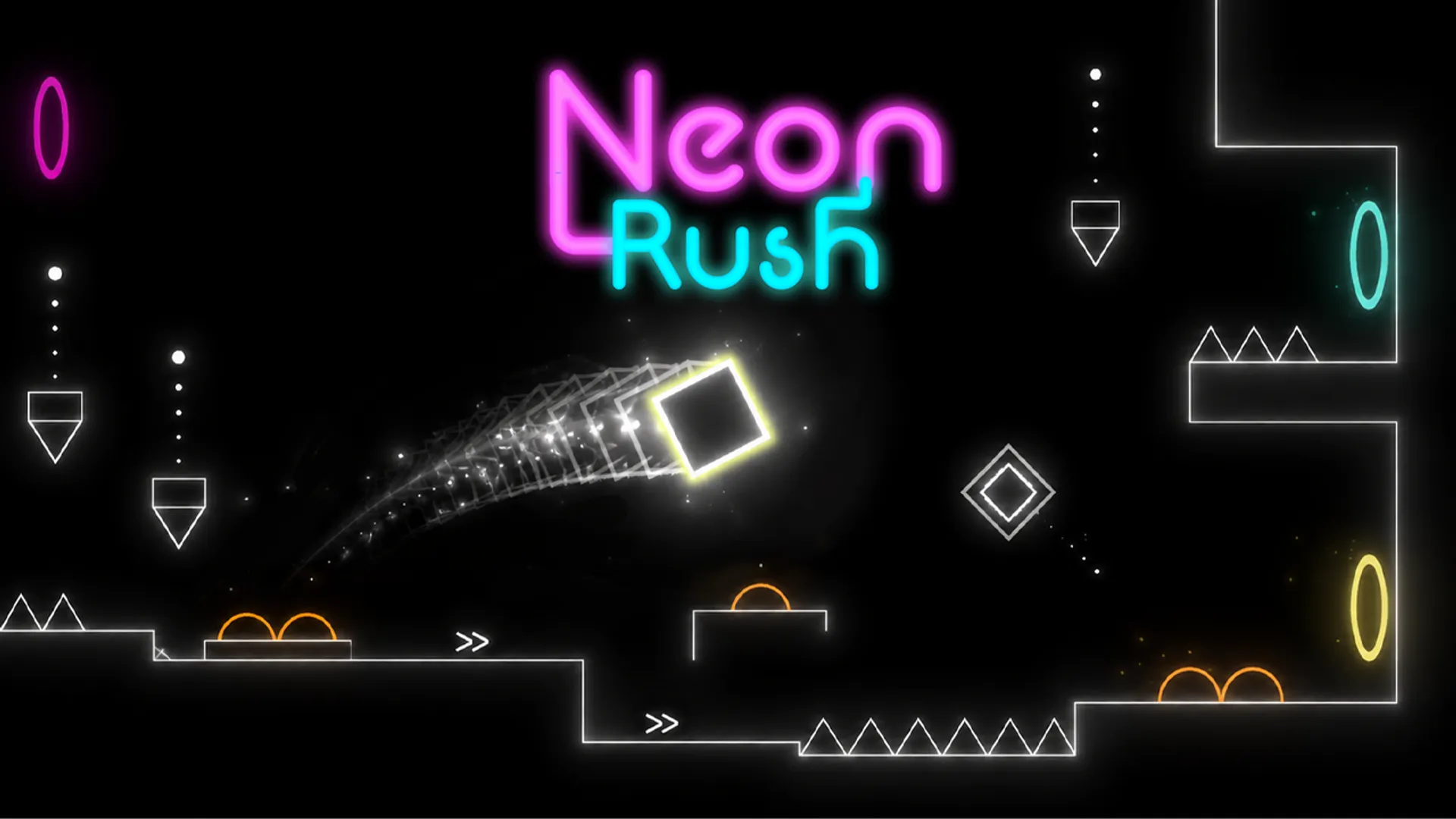
The aesthetic of Neon Rush is deceptively inviting. With its vibrant colors and pumping electronic soundtrack, it initially presents itself as a casual arcade jumper. However, beneath that glowing exterior lies one of the most punishing and mechanically demanding platforming engines ever designed. In Neon Rush, the environment itself is hostile, moving and shifting in tandem with the heavy basslines. A veteran player knows that you cannot rely on visual reaction speed alone to conquer these stages. Survival in Neon Rush demands absolute audio-visual synchronization and brutal muscle memory. Every spike, every moving platform, and every gravity-inverting portal requires a frame-perfect input, transforming a simple jumper into a grueling test of human reflexes.
The core gameplay loop of Neon Rush is inextricably tied to its audio design. This is not a game where the music is merely background noise; the soundtrack is the map. Obstacles spawn, lasers fire, and platforms materialize exactly on the beat. If you attempt to play Neon Rush with the sound muted, you are effectively playing blind. The highest tier of players utilize the audio cues to preemptively time their inputs before the visual hazard even renders on screen.
This mechanic creates an intense state of "flow." When you string together a dozen flawless jumps in Neon Rush, you stop looking at your character entirely. Instead, you focus on the right edge of the screen, letting the rhythmic thumping of the bass dictate the pressure on your spacebar. A microsecond of hesitation, or a jump executed slightly off-beat, instantly shatters your momentum and results in an unforgiving reset back to the starting line.
As the stages progress, Neon Rush introduces its most disorienting mechanic: the gravity portal. Passing through one of these glowing rings instantly flips your character to the ceiling, reversing your vertical inputs. Navigating these gravity shifts in Neon Rush requires massive cognitive rewiring. A sequence that starts as a standard floor jump will suddenly demand inverted ceiling maneuvers, all while the scrolling speed of the camera continues to accelerate.
The true challenge emerges when Neon Rush rapidly alternates between standard and inverted gravity mid-jump. You will frequently encounter sections where you must leap from a floor ramp, hit a gravity switch in mid-air, and stick a landing on a ceiling platform covered in spikes. Memorizing the exact sequence of these inverted zones is the only way to avoid plunging into the neon abyss below.
Periodically, Neon Rush strips away the platforms entirely, forcing your avatar into a vehicle-based flight mode. In these sections, the physics engine changes from a standard jump arc to a continuous thrust system. Holding the input causes your ship to climb rapidly, while releasing it drops you like a stone. The corridors in these flight zones are agonizingly narrow. The flight mechanics in Neon Rush are notoriously sensitive; over-correcting your altitude by even a millimeter guarantees a fiery collision with the jagged geometric terrain.
Unlike modern forgiving platformers, Neon Rush does not feature mid-level checkpoints. Every attempt is an all-or-nothing gauntlet. If you fail at the 99% mark, you are sent all the way back to zero percent. This structural decision forces players to build immense psychological resilience. The difficulty curve in Neon Rush is essentially a sheer cliff, demanding that you execute a massive sequence of complex inputs flawlessly for over two straight minutes.
The Practice Mode Strategy:Because the later sections of a level are so heavily guarded by the earlier segments, brute-forcing your way through Neon Rush is mathematically inefficient. Elite players rely heavily on the built-in practice mode, which allows you to place manual checkpoints. If a specific gravity-flip section at the 75% mark keeps ending your run, you must isolate that single obstacle in practice mode. In Neon Rush, running a difficult segment fifty times in isolation is far faster than re-playing the entire first minute of the track just to get another attempt at the choke point.
"Do not trust your eyes in Neon Rush; trust the kick drum. If you try to react to the spikes as they appear on the edge of your monitor, you will always be a frame late. You have to jump when the music tells you to jump, even if the gap hasn't fully rendered yet." - Veteran Speedrunning Insight
| Developer | AZ Game Studio (Neon Rush) |
|---|---|
| Engine Concept | Audio-Synced Hitbox Evasion |
| Core Threat | Static Spikes & Gravity Shifts in Neon Rush |
| Victory Condition | Achieve 100% Track Completion in Neon Rush |