
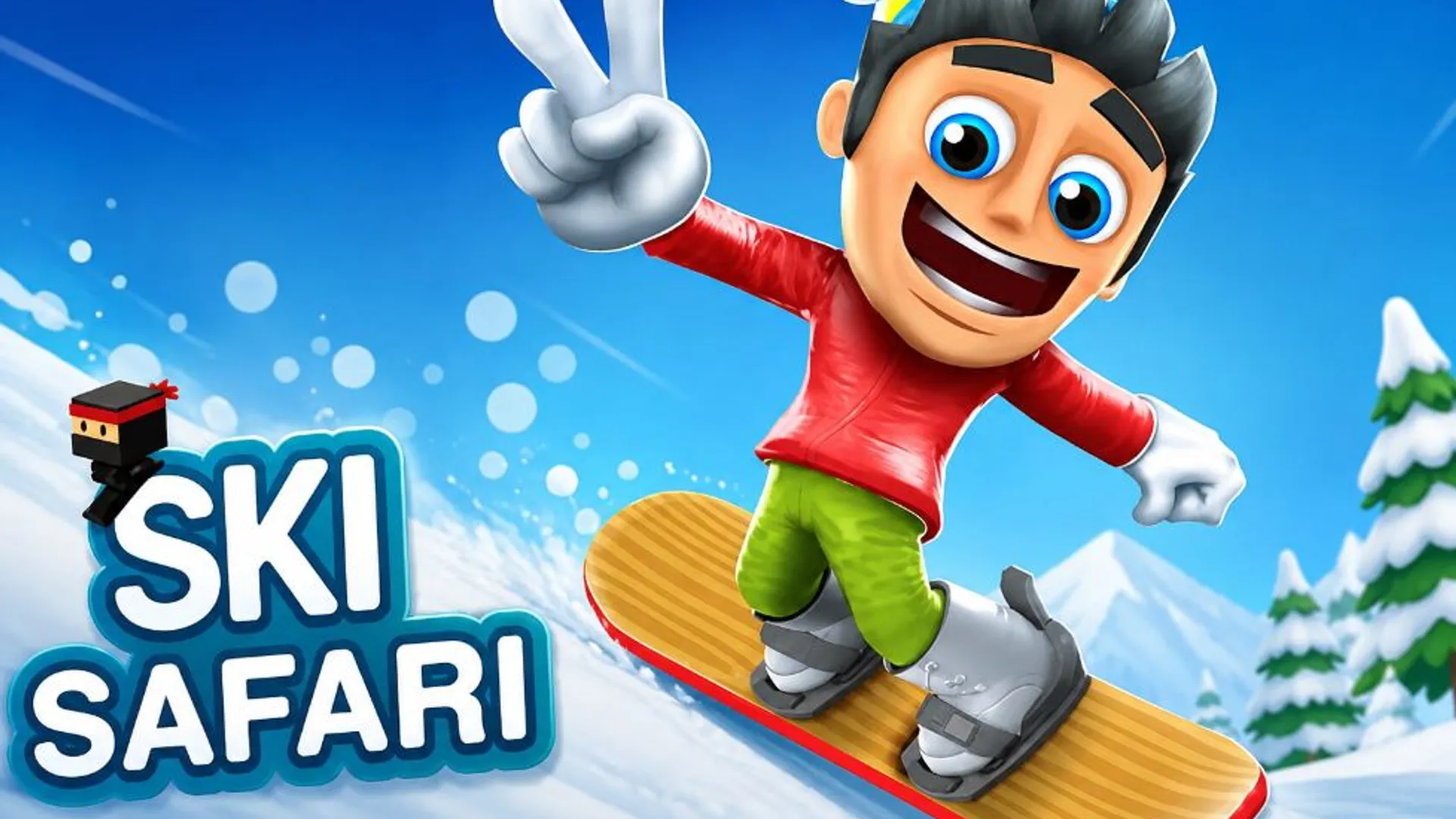










Ski Safari: Surviving Avalanches on Endless Mountains
In modern mobile and browser-based arcade titles, Ski Safari stands as a brilliant example of momentum-based physics design. Its premise is instantly understandable: Sven is sleeping in his cabin when a colossal avalanche rips its structure apart. From that very first second, you are propelled forward down a seemingly infinite alpine slope. A fundamental constraint of Ski Safari is an encroaching wall of snow chasing you from screen left. You do not control acceleration directly in Ski Safari; instead, you manage your character's vertical clearance and rotation to maintain speed. It is a desperate race where failure to maintain velocity results in instant termination by avalanches.
Unlike endless runners relying on grid-based lane shifting, Ski Safari uses continuous physics simulation on a 2D plane. Terrain generation is entirely procedural, meaning you can never memorize specific layouts in Ski Safari. You must react dynamically to sudden drops, jagged rocks, and steep inclines. Primary interaction in Ski Safari is reduced to one single input: clicking or tapping your screen to jump. Simplicity of this control scheme allows developers to introduce increasingly complex environmental hazards without overwhelming players, making every run in Ski Safari a pure test of reflex and physical intuition.
Mastering One-Button Mechanics
A single tap is your only defense against treacherous terrain in Ski Safari. Tapping once executes a jump, allowing you to clear rocks and cabins that would otherwise halt your momentum. However, if you hold your button while Sven is airborne in Ski Safari, he will initiate backflips. This is where skill ceilings reside. Successfully landing backflips provides massive bursts of speed and instantly increases your score multiplier. Conversely, under-rotating or over-rotating backflips will cause you to crash face-first into snowbanks in Ski Safari.
Crashing is not an immediate game over in Ski Safari, provided danger is far enough behind you. When you fall, Sven tumbles uncontrollably. You must rapidly tap your screen to force him back onto his skis. This recovery mechanic adds frantic layers of tension to Ski Safari. You are constantly watching your screen edge, calculating if you have enough time to stand up before whiteouts consume you. Every millisecond wasted on ground textures in Ski Safari brings death closer.
Simulation Technical Specifications
| Developer | Sleepy Z Studios |
|---|---|
| Genre | Physics Endless Runner |
| Input Method | Single Tap / Click to Jump (Hold to flip) |
| Core Mechanic | Momentum preservation and rotational physics |
Animal Assistants and Vehicle Integration
To survive escalating speeds of avalanches, Sven cannot rely on his skis alone. Mountainsides in Ski Safari are populated with local wildlife functioning as rideable power-ups. When you ski over penguins, Sven grabs them and uses their bellies as slick snowboards. Penguins provide speed boosts and act as one-hit shields in Ski Safari. If you crash into rocks while holding penguins, animals take hits and disappear, allowing Sven to continue unharmed. This armor system is crucial for deep runs in Ski Safari.
Understanding Helper Hierarchies
Animal helpers follow strict hierarchies of durability and speed in Ski Safari. Yetis are significant upgrades over penguins. When riding on Yeti shoulders, you can smash directly through solid rocks and wooden cabins without losing momentum. Yetis in Ski Safari are ultimate bulldozers, allowing you to ignore low-tier obstacles entirely. However, Yetis cannot perform backflips as quickly as Sven, requiring you to adjust rotational timing when attempting aerial tricks in Ski Safari.
For pure speed, eagles are unmatched. Catching eagles allows you to take flight, flying over all ground-based hazards in Ski Safari. Flights are temporary, but they provide massive vertical advantages and allow you to collect high-altitude coins. Knowing when to transition between animals—abandoning damaged Yetis to grab fresh eagles—is a mark of expert players in Ski Safari.
Mechanics of Stacking
Brilliant system design in Ski Safari allows players to stack vehicles and animals simultaneously. Occasionally, you will encounter snowmobiles. By themselves, they are fast, multi-hit vehicles. But in Ski Safari, you can collect passengers while driving. You can have Yetis sitting behind you, and penguins sitting on Yetis. This ridiculous tower of wildlife turns snowmobiles into unstoppable juggernauts in Ski Safari. It absorbs multiple impacts and maintains absolute maximum velocity, giving you best chances to outpace disaster.
- Trajectory Alignment: Ensure your skis are perfectly parallel with ground textures when landing in Ski Safari to maintain your speed multiplier.
- Shield Cycling: Always prioritize grabbing penguins if you are currently vulnerable, even if it means missing a few coins in Ski Safari.
- Cloud Bouncing: Hitting clouds at upper screen edges provides soft bounces, allowing for extended airtime and multiple backflips.
- Recovery Mashing: Do not panic when you fall; focus all physical effort on tapping your screen as rapidly as humanly possible to recover in Ski Safari.
Meta-Progression and Economic Optimization
While single runs provide immediate adrenaline, long-term hooks of Ski Safari lie in its meta-progression systems. This game utilizes tiered objective systems, commonly referred to as ranks or levels. To rank up in Ski Safari, you must complete specific challenges during your runs, such as "Do a double backflip while riding a Yeti" or "Smash through 3 cabins." Ranking up permanently increases your starting score multiplier in Ski Safari, which is mathematically necessary to achieve high scores on global leaderboards.
Strategic Coin Collection
Scattered across mountains are gold coins. Collecting currency is entirely optional for immediate survival, but mandatory for long-term progression in Ski Safari. Procedural generation algorithms often place high-density coin clusters in dangerous locations, such as tight valleys directly before rock formations. You must calculate risk-reward ratios in real-time in Ski Safari. Is extra currency worth potential crashes that might let avalanches catch you?
Purchasing Mechanical Upgrades
Collected currency is spent in shops between runs. You can purchase cosmetic outfits, but most important purchases in Ski Safari are mechanical upgrades. You can buy equipment allowing you to start runs riding snowmobiles or rockets. These head starts are vital for skipping slow, dangerous early phases and immediately launching into high-velocity gameplay in Ski Safari.
"A biggest mistake players make is getting greedy with backflips. Just because you have airtime doesn't mean you should try for triple rotations. Landing on your head destroys multipliers. Play it safe, land single flips perfectly, and keep speed up. Ski Safari rewards consistency over flashy gambles." - Arcade Veteran
Ultimately, enduring appeal of Ski Safari lies in flawless execution of simple concepts. Physics engines are incredibly consistent, ensuring every crash feels like player fault rather than a glitch. Visual clarity allows you to read terrain instantly, and dynamic soundtracks perfectly match frantic energy of escapes. Whether you are aiming for new distance records or just trying to finish frustrating challenges, Ski Safari delivers tightly focused, highly addictive arcade experiences.