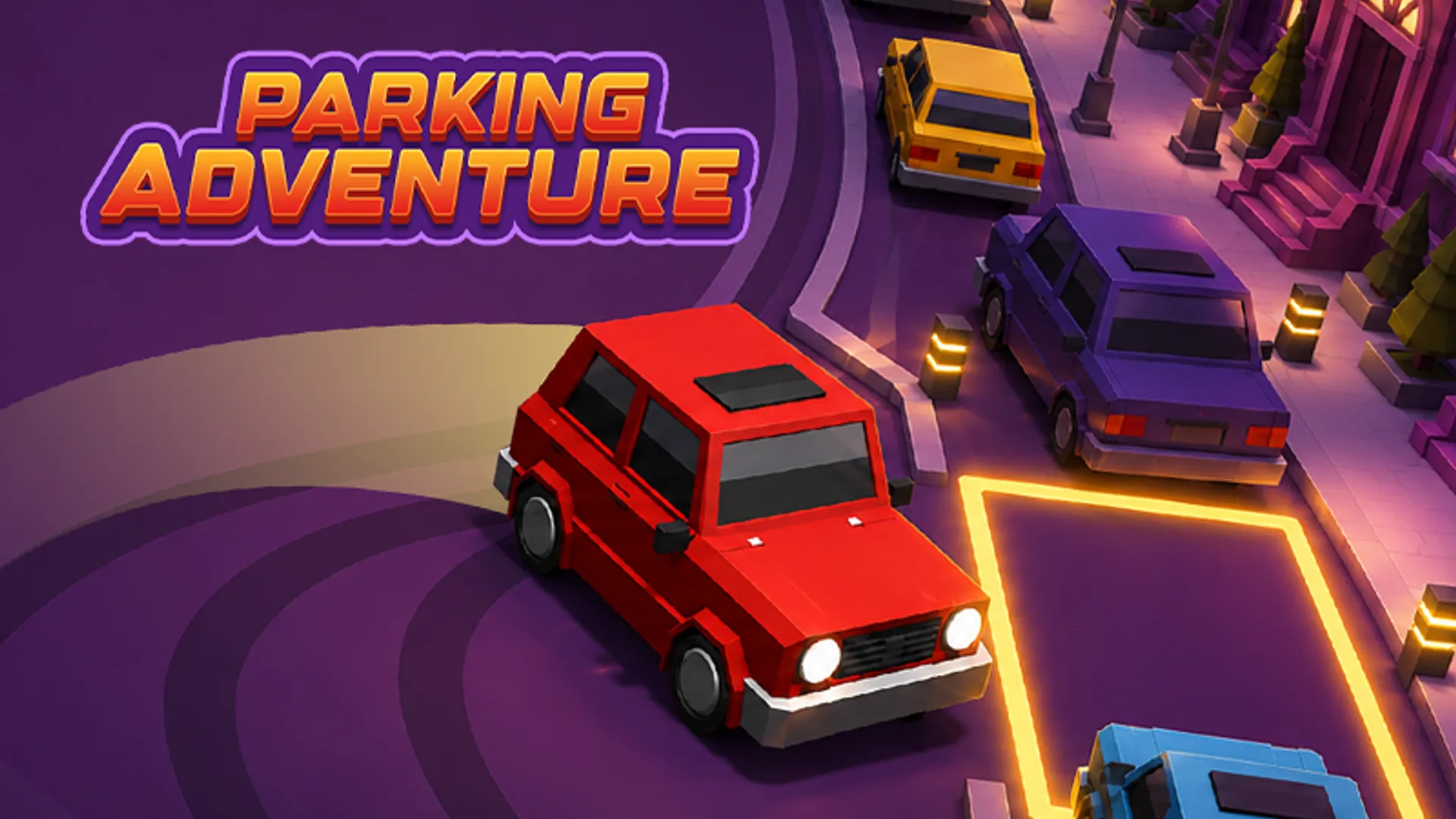
At first glance, driving a virtual car into a highlighted rectangular box doesn't sound like a high-stakes endeavor. However, Parking Adventure aggressively shatters that assumption. This is not a racing game; it is a meticulous geometric puzzle disguised as an arcade driving simulator. You are tasked with navigating heavy civilian traffic, scanning busy curbsides, and executing incredibly precise maneuvers to secure a spot before the timer expires or a rival driver steals it. In Parking Adventure, the core difficulty lies entirely in reverse-steering physics. Many players are completely unequipped to handle the inverted control logic required to parallel park under pressure. A single scrape against a civilian bumper results in an instant failure, meaning you must perfectly calculate your rear axle pivot and turning radius long before your tires even touch the target zone.
The fundamental mechanic that separates Parking Adventure from standard top-down drivers is its realistic implementation of front-wheel steering. When you drive forward, the rear of the car dutifully follows the nose. But when you shift into reverse, the steering geometry violently flips. To successfully reverse into an angled slot in Parking Adventure, you must visualize an invisible arc originating from your rear tires.
Rookies inevitably fail because they turn the steering wheel too early in Parking Adventure. If you crank the wheel while reversing before your rear bumper clears the obstacle, the front nose of your vehicle will swing wide in the opposite direction in Parking Adventure, scraping the paint off the adjacent parked car. Elite drivers understand that you must drive completely past the slot in Parking Adventure, align the rear axle with the outer edge of the space, and only then initiate the hard reverse cut.
As you progress into the later urban stages of Parking Adventure, the game strips away the angled slots and introduces the dreaded parallel park. You are forced to wedge a massive sedan into a gap barely larger than the vehicle itself. Attempting to pull forward into these spaces is mathematically impossible due to the turning radius constraints. You must utilize the three-point system.
First, you must pull alongside the front vehicle in Parking Adventure. Second, you cut the wheel completely toward the curb and reverse until your car is at a 45-degree angle. The most critical step—and the one where most runs die in Parking Adventure—is the third motion: straightening the wheel and reversing straight back until the nose clears the front car, then cutting hard away from the curb to tuck the front end in. Rushing any of these three distinct mechanical inputs guarantees a catastrophic failure.
If the spatial puzzles weren't difficult enough, Parking Adventure also overlays a strict resource management layer. You are constantly fighting two enemies in Parking Adventure: a ticking countdown clock and unpredictable AI traffic. While you are carefully aligning your three-point turn, civilian vehicles continue to travel down the active lane in Parking Adventure. If an AI car rear-ends you while you are protruding into the street in Parking Adventure, the game assigns the fault to you, terminating the level.
The progression system constantly alters the physical dimensions of your avatar. You begin with a highly maneuverable compact hatchback, but as you earn cash and unlock new cities, Parking Adventure forces you into the driver's seat of elongated station wagons, heavy pickup trucks, and eventually, cumbersome delivery vans.
The Long-Wheelbase Trap:Every time you upgrade to a larger vehicle in Parking Adventure, your established muscle memory becomes entirely obsolete. A long-wheelbase truck requires drastically different pivot points than a compact car. If you apply hatchback timing to a delivery van, the rear tires will clip the curb, completely destroying your alignment. You must re-calibrate your visual cues for every single vehicle class, adding a massive layer of replay value to the core simulation loop.
Navigating the Blind Spot Economy:As the difficulty scales, Parking Adventure removes the luxury of full visual clarity. The camera angle remains fixed in a top-down isometric view, but the introduction of large architectural obstacles—such as elevated train tracks, heavy foliage, and multi-story parking garage pillars—forces you to drive partially blind. You are no longer just judging the distance between your bumper and the curb; you are extrapolating your vehicle's position based on limited visual information.
The most punishing levels in Parking Adventure actively weaponize these blind spots. They will place a highly lucrative parking slot behind a massive delivery truck, requiring you to execute a blind reverse-entry maneuver. To survive these zones, veteran drivers utilize "shadow tracking." By closely watching the artificial shadow cast by your vehicle on the asphalt, you can determine your exact alignment relative to the unseen obstacles, allowing you to slide into the spot without ever actually seeing the lines.
"The biggest mistake players make is focusing on the front bumper. In Parking Adventure, the front bumper is irrelevant until the very last second. Keep your eyes glued to the rear wheels. If the rear wheels are on the correct trajectory, the front of the car will naturally follow." - Veteran Driving Strategy
| Developer | AZ Game Studio (Parking Adventure) |
|---|---|
| Engine Concept | Reverse Kinematics & Geometry |
| Core Threat | Time Limits & Civilian Traffic |
| Input Method | Forward/Reverse Steering Pivot |