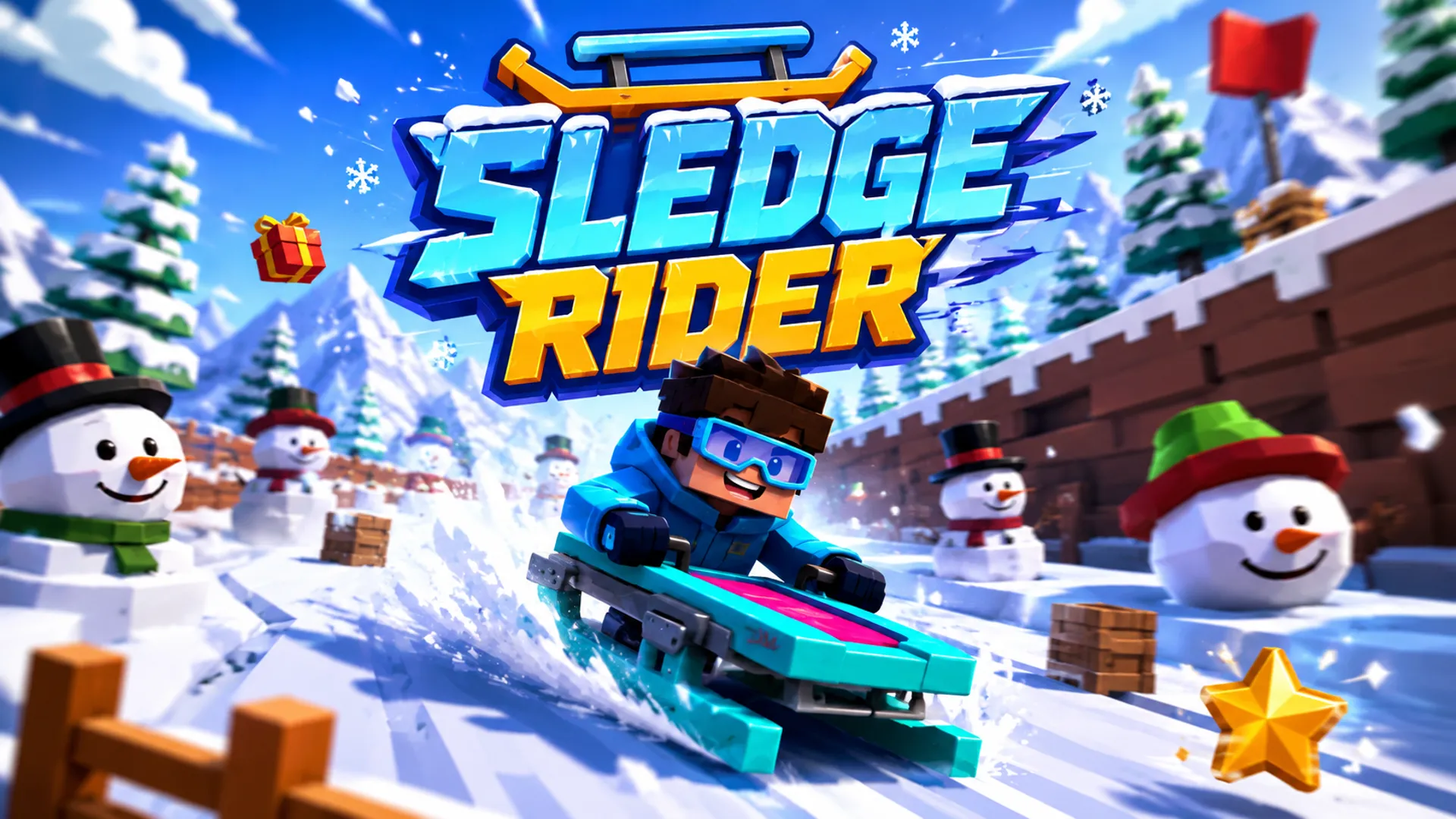
Many endless runners place the player on a flat, predictable grid, relying solely on lane-swapping mechanics to generate difficulty. Sledge Rider completely abandons that safety net, dropping you onto a steeply angled, dynamically generated alpine slope where gravity is your worst enemy. From the moment your sled hits the snow, the physics engine takes over. You are in a constant state of accelerating descent, and every input you make is a battle against forward momentum. In Sledge Rider, you do not have brakes. Your only method of survival is micro-managing your steering to thread the needle through dense pine forests, jagged rock formations, and lethal ice crevices. This is not a relaxing winter sports simulation; it is a high-speed, high-stress visual processing test that punishes over-steering with immediate, brutal crashes.
The most critical mechanic to master in Sledge Rider is understanding how your vehicle interacts with different types of terrain. The mountain is not a uniform white canvas. As you descend, you will seamlessly transition between deep powder snow and solid, frictionless ice sheets. These surface changes completely alter the handling model of your sled. When riding on standard snow in Sledge Rider, your turns are relatively tight and responsive, allowing for quick adjustments to dodge sudden obstacles.
However, hitting an ice patch strips away all your traction. On ice, turning inputs result in massive, uncontrollable drifts. If you attempt a sharp turn on a frozen surface, the physics engine in Sledge Rider will send your sled into a violent horizontal slide, almost guaranteeing a fatal collision with the nearest tree. Elite players memorize the visual texture of the snow, adjusting their turning aggression milliseconds before their runners hit a low-friction zone.
As your run extends, your descent velocity increases exponentially. This acceleration creates a severe compression of your reaction window. At maximum speed in Sledge Rider, reacting to the obstacle directly in front of you is mathematically impossible; the collision will occur before your steering input registers. To survive the late-game stages, you must shift your visual focus to the absolute top edge of the screen. You are no longer driving the sled; you are charting a macro-path through the upcoming tree line.
Furthermore, Sledge Rider utilizes the mountain's geometry against you. Sudden drop-offs and ramps create massive blind spots. When launching off a natural ramp, you cannot see the landing zone. In these airborne moments, you must resist the urge to turn, as landing sideways in Sledge Rider triggers an immediate tumbling crash. You have to commit to your trajectory and pray the procedural generation didn't place a boulder directly in your flight path.
Scattered across the lethal descent are wrapped gifts, which serve as the game's primary scoring metric. The developer's placement of these items in Sledge Rider is intentionally malicious. High-value gifts are frequently placed on the extreme edges of the track or dangerously close to lethal obstacles. Attempting to collect every single item is a guaranteed death sentence. True high-score chasers in Sledge Rider learn to ignore the "bait" gifts, only altering their safe trajectory for pickups that align with a clean escape vector.
Because the mountain is procedurally generated, you can never rely on rote memorization. Every run presents a completely unique arrangement of hazards. The only constant in Sledge Rider is the physics engine. To achieve a high score, you must stop treating the game as an obstacle course and start treating it as a fluid dynamics problem. You must flow with the momentum, making microscopic steering adjustments rather than sharp, panicked jerks.
The Over-Steering Trap:The number one cause of death for rookies in Sledge Rider is over-correction. When a tree suddenly appears, the instinct is to hold the turn key until you are clear. However, because you have no brakes, holding a turn drastically alters your lateral vector. You might dodge the first tree, but your sled will slide out of control directly into a secondary hazard. You must learn to "tap-steer" in Sledge Rider, altering your angle by just a few degrees to scrape past danger without losing your center of gravity.
"If you're looking at your sled, you're already dead. In Sledge Rider, your eyes should be locked on the horizon line. You have to read the gaps in the trees before the trees even fully render on the screen." - Veteran Downhill Strategy
| Developer | 1Games IO (Sledge Rider) |
|---|---|
| Engine Concept | Procedural Gravity Acceleration in Sledge Rider |
| Core Threat | Over-Steering & Blind Ramps |
| Victory Condition | Survive the Endless Descent in Sledge Rider |