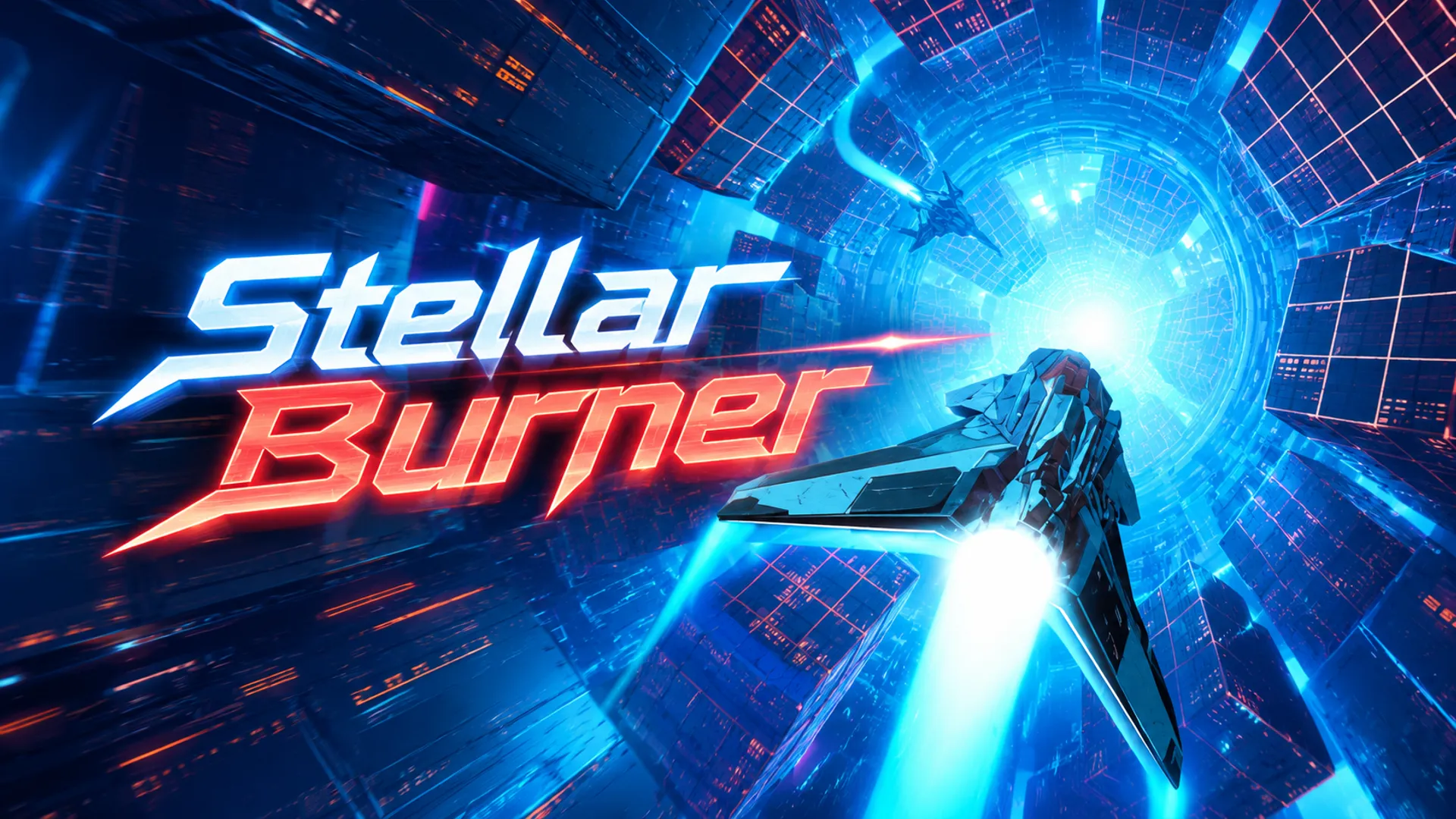
Many modern flight simulators overwhelm the player with incredibly dense UI elements, dozens of keybinds, and complex atmospheric physics. Stellar Burner violently rejects that design philosophy. It drops you into the cockpit of an incredibly fragile, high-thrust spacecraft and asks you one simple question: how fast can your brain process geometric threats? From the very first second you ignite the engine, Stellar Burner locks you into a continuously accelerating forward trajectory. You do not have a brake pedal. Your only method of interacting with the hostile environment is a pair of hyper-sensitive lateral thrusters. At lower speeds, dodging the static pillars and closing bulkheads feels manageable, almost relaxing. But as your velocity crosses the critical threshold in Stellar Burner, the game transforms into a brutal, unforgiving test of peripheral vision and micro-adjustments.
The defining mechanical quirk of Stellar Burner is its momentum-heavy handling model. When you engage a directional thruster, your ship doesn't just snap instantly to the new lane in Stellar Burner. It builds lateral momentum. If you hold the thruster for a fraction of a second too long, your ship will continue to drift sideways long after you release the key. This fundamental physics rule makes Stellar Burner incredibly punishing for players who rely on panic-swiping.
Every movement must be deliberate and measured. The most common cause of death for rookies in Stellar Burner is not failing to dodge the first obstacle; it is the over-correction applied while dodging the first obstacle that sends them smashing into the second. Elite players mitigate this by utilizing "counter-burns." Instead of simply releasing the left thruster, they briefly tap the right thruster to manually arrest their lateral momentum, snapping their ship back into a stable, straight trajectory before the next hazard appears in Stellar Burner.
Rote memorization will not save you here. The level architecture in Stellar Burner is entirely procedurally generated. Each run mathematically pieces together different structural modules—from narrow, spinning fan blades to massive, interlocking geometric blocks. Because the map is constantly shifting, you cannot rely on muscle memory to pre-plan your route. Instead, Stellar Burner forces you to read the "negative space" on the screen.
You must train your eyes to ignore the bright, neon-colored obstacles and focus entirely on the dark gaps between them. As your speed increases, the visual information density in Stellar Burner becomes overwhelming. The background stars blur into solid lines, and the obstacle textures warp. In these extreme late-game states, you have less than 200 milliseconds to identify a safe passage and execute the required thruster burst.
To consistently survive the hardest zones in Stellar Burner, you must possess a perfect, intuitive understanding of your ship's physical footprint. The collision hitbox is remarkably strict and precise. It is shaped exactly like the angular chassis of your craft, meaning that the wings are the most vulnerable points. When threading the needle through a closing blast door, many players instinctively center their ship. However, advanced pilots in Stellar Burner will subtly rotate their craft, utilizing the narrower profile of the ship's nose to slip through gaps that appear mathematically impossible.
Stellar Burner is a game of repetition. You will crash. You will crash hundreds of times. The developer intentionally removed all loading screens and death animations to facilitate an instant-restart loop. The moment your hull shatters against a pillar, the camera snaps back to the starting line, and the engine immediately reigns. This lack of downtime in Stellar Burner is a double-edged sword.
The Tilt Factor:While the instant restart keeps you in the "zone," it also drastically accelerates player fatigue and frustration. When you die on a particularly promising run in Stellar Burner, the immediate respawn tempts you to rush back to your previous milestone. This leads to sloppy thruster control in the early, easy zones, causing embarrassing early deaths and triggering a vicious cycle of "tilt." Recognizing when your reaction times are degrading and forcing yourself to take a physical break is a highly underrated skill in Stellar Burner.
Decoding Audio Cues:In addition to the overwhelming visual noise, the auditory design in Stellar Burner is surprisingly critical for high-level survival. The engine hum of your spacecraft directly correlates with your forward velocity. As the pitch of the thruster noise whines higher and higher, the engine is subliminally warning you that your reaction window is shrinking.
Furthermore, specific hazards emit distinct directional audio pings milliseconds before they fully render on the screen. For example, the rotating fan blades generate a low-frequency hum that grows louder based on their proximity to your flight path. Top-tier pilots in Stellar Burner often play with high-fidelity headphones, utilizing this spatial audio to instinctively begin their lateral drifts before their eyes have even processed the visual threat. Ignoring the soundscape in Stellar Burner is equivalent to flying blind.
"The secret to breaking the 5-minute barrier in Stellar Burner isn't moving faster; it's moving less. Every unnecessary thruster burn introduces instability. Find the center line, hold it, and only deviate when the corridor literally forces you to. Efficiency is survival." - Veteran Pilot Analysis
| Developer | 1Games IO (Stellar Burner) |
|---|---|
| Engine Concept | Continuous Forward Velocity |
| Core Threat | Procedural Geometric Bottlenecks |
| Input Method | Binary Lateral Thrusters |